


St. Vincent de Paul thrift stores already do the most challenging part of retail: sourcing donations and serving their communities with purpose. What many stores are realizing now is that e-commerce presents a powerful opportunity to extend that impact even further.
Across the SVdP network, more thrift stores are introducing e-commerce programs to boost revenue, attract new customers, and scale their mission. Rather than listing every item online or overhauling their entire operation, successful programs take a strategic, intentional approach, focusing on the right items and the right selling method.
This article outlines the top five reasons SVdP thrift stores are expanding into online selling, based on real-world results and proven operational models.Reason 1: E-Commerce Expands Reach From Local Shoppers to Global Demand
Your donation floor is local. Your buyer market online is global.
Recent data indicate that approximately 59% of global online shoppers purchase from retailers outside their own country, and 35% do so at least monthly, demonstrating that demand is no longer limited by geography.
(Source: DHL Cross-Border E-Commerce Trends)
In-store sales are often limited by foot traffic and the location of the store. Online, especially on platforms like eBay, buyers can discover your items from across the country or around the world. This is especially impactful for specialty or high-value donations, where the ideal buyer may not live nearby.
This is where SVdP thrift store online selling becomes a mission advantage. A rare collectible or designer item can generate significantly more revenue online, with proceeds flowing directly back into local programs.
Local mission. Global buyers.
Want a step-by-step breakdown of starting on eBay?
Reason 2: Specialty Items Often Sell for 3–10× More Online
Not every item belongs online, and that’s the point.
The most successful SVdP e-commerce programs focus on premium outliers rather than volume. Items that may sell for a modest price in-store often command significantly higher prices online when matched with the right buyer.
Common examples include:
- Fine or branded jewelry
- Collectibles and media
- Designer or vintage apparel
- Electronics and small appliances
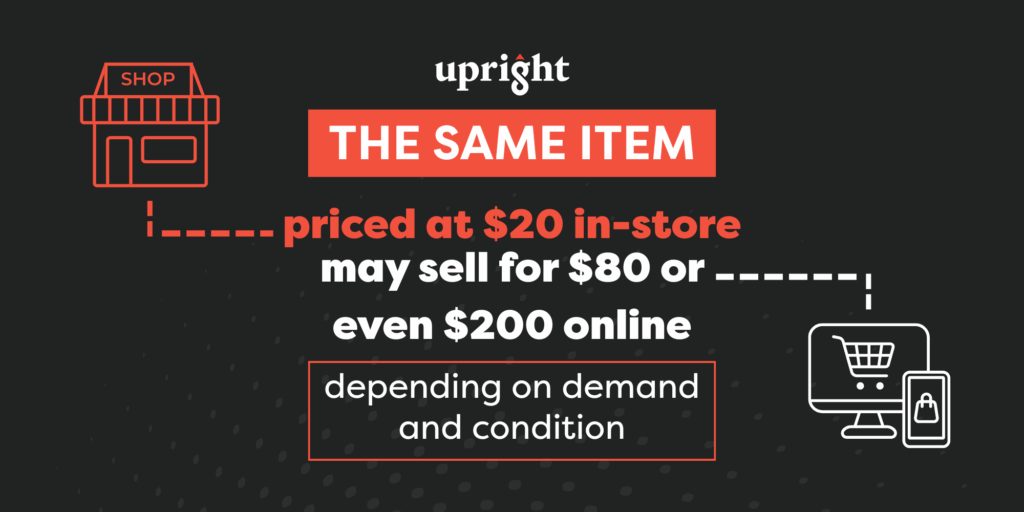
The same item, priced at $20 in-store, may sell for $80 or even $200 online, depending on demand and condition.
A simple guiding rule: Don’t list everything. List what’s worth it.
By concentrating effort where margins are highest, stores avoid overwhelming staff while still realizing meaningful revenue gains.
Callout Box: Margin potential: Specialty items often yield 3 to 10 times typical thrift pricing.
Reason 3: It’s a Smarter Growth Path Than Opening a New Store
Opening a new physical location can be expensive and operationally complex. E-commerce offers a more flexible growth path.
Compared to launching a new store, adding an online channel typically means:
- Lower upfront investment
- Lower ongoing overhead
- Faster time to revenue
- No geographic constraints
Many SVdP stores begin generating online revenue in as little as 4 to 8 weeks, sometimes faster. By using Upright Lister, they expand reach without expanding square footage.
From a leadership perspective, e-commerce is often the most capital-efficient way to grow mission funding without adding long-term fixed costs.
Callout Box: Time to revenue: E-commerce can produce results in 4 to 8 weeks.
Reason 4: You Can Start Small Without Disrupting Your Thrift Store
A common concern is that e-commerce will compete with in-store sales or overwhelm staff. In practice, successful programs are designed to complement existing operations.
The most effective approach is dual channel:
- Thrift store: volume, accessibility, community presence
- E-commerce: specialty items, margin optimization, maximization
Many stores start with a single shelf or rack for online items, a modest daily listing goal, or a simple photo setup. This keeps e-commerce manageable and predictable while allowing teams to test workflows, refine processes, and build confidence before scaling.
Want the complete roadmap?
Download the E-Commerce Opportunity for St. Vincent de Paul Guide.
Reason 5: Efficiency Creates More Mission Funding Per Hour
Labor efficiency is where e-commerce programs truly unlock scale.
As programs mature, improvements in listing speed, consistency, and workflow discipline directly translate into more revenue per hour of staff time.
By using structured e-commerce listing workflows and resale listing software like Upright Lister, SVdP stores can:
- Reduce listing time by 50% or more
- Improve consistency across listings
- Minimize rework caused by errors or omissions
Callout Box: Efficiency is about generating more mission impact from the same hours, not working more.
What This Looks Like in the Real World: SVdP National Store
Read the full case study: Scaling for Good: St. Vincent de Paul’s E-Commerce Strategy
After formalizing its e-commerce approach with Upright Lister, one SVdP national store saw:
- Monthly revenue increase from approximately $2,500 to $15,000
- Processing time drop from 15 to 20 minutes per item to under 5 minutes
- Improved staff morale as workflows became simpler and results more visible
Clear processes and measurable outcomes help teams stay motivated, and give leadership confidence to scale.
Quick Filter: What Belongs Online vs. In-Store
Not sure what to list online? Use this simple filter.
Items that perform best online are:
- Easy to search for
- Have an established market value
- Sell for significantly more than typical thrift pricing
Common high-performing categories include:
- Fine or branded jewelry (sterling, gold)
- Vintage or designer apparel
- Collectibles (games, books, vinyl)
- Electronics and small appliances
- Unique housewares or art
If an item checks multiple boxes, it’s a strong e-commerce candidate.
Ready to Explore E-Commerce for Your SVdP?
Read the eBay Getting Started Guide
Get a Demo Now:
Frequently Asked Questions
Do we need to list everything online?
No. Most stores focus on premium items with higher margin potential.
How fast can an SVdP store start seeing revenue?
Many see results within 4–8 weeks.
Is e-commerce competing with our thrift store?
No. It complements in-store sales by maximizing the sale of specialty items.
What categories perform best for SVdP online?
Jewelry, electronics, collectibles, designer apparel, and unique goods.
What’s the easiest platform to start with?
Many SVdP stores begin with eBay due to its built-in demand.
How does Upright help?
Through resale listing software, onboarding support, and professional services.