

Shipping fees can quickly eat into a thrift e-commerce operation’s profitability. And as carrier rates, dimensional-weight rules, and shipping fees continue to change, controlling fulfillment costs takes more than simply choosing the cheapest label.
That’s especially true in secondhand. Your team might ship a T-shirt, pair of boots, vintage record, and collectible lamp in the same afternoon. Each item requiring a different box, level of protection, and shipping service.
These five practical tips can help thrift teams reduce e-commerce shipping costs without sacrificing the buyer experience.
In this article
How can thrift stores reduce e-commerce shipping costs?
Right-size packages, accurately weigh and measure shipments, compare carrier and service rates, use discounted marketplace labels when available, and track shipping margin to identify where recurring losses are happening.
How do I ship cheaper on eBay?
Compare carrier services through eBay Labels, enter accurate package weights and dimensions, and use calculated shipping when appropriate. eBay Labels provides negotiated rates from USPS, UPS, and FedEx that can be lower than standard retail carrier rates.
What is the cheapest way to ship clothes?
For lightweight, non-fragile clothing, a properly sized poly mailer can reduce both packaging weight and dimensions compared with a box. The cheapest shipping service still depends on the package’s weight, size, destination, and required delivery speed.
Why Excessive Shipping Costs Happen
Shipping can be more complicated for thrift e-commerce operators than traditional retailers.
Most thrift organizations don’t have long runs of identical products fitting neatly into the same packaging. Nearly every item is a unique SKU and may need to be weighed, measured, and packed individually.
That makes it harder to have the right-size packaging on a consistent basis. A shipping team may need dozens of box sizes, mailers, and packing materials to handle everything from apparel to electronics, housewares, books, and collectibles.
Many thrift e-commerce operations also fulfill orders from a single central facility or a limited number of locations. That can give teams less flexibility to shorten the shipping distance by fulfilling an order closer to the buyer.
If your operation fulfills from New York and your buyer is in Sacramento, for example, you may not have a second warehouse available to reduce that shipping distance.
Finally, human error can create avoidable costs.
If an employee enters the wrong weight or box dimensions, chooses an unnecessarily expensive service, or uses an oversized box for a small item, the organization can pay more than expected.
That matters even more as carriers increasingly account for the space a package occupies. Not just what it weighs.
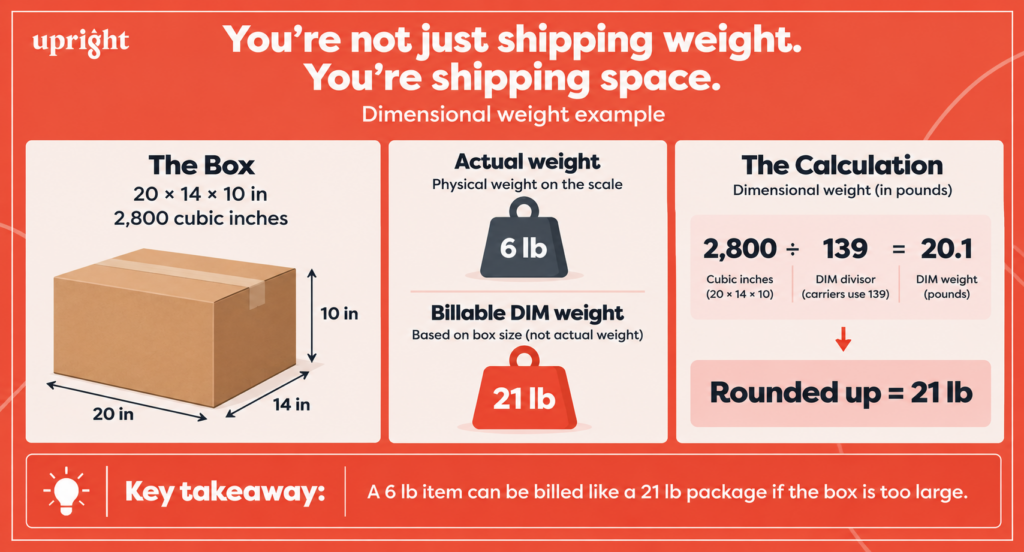
USPS, for example, updated its dimensional-weight rules in July 2026. For qualifying Ground Advantage parcels larger than one cubic foot, postage is based on actual weight or dimensional weight, whichever is greater. USPS now uses a dimensional divisor of 139.
You’re not just shipping weight. You’re shipping space.
Consider a 6-pound item packed in a 20 × 14 × 10-inch box.
That box occupies 2,800 cubic inches.
2,800 ÷ 139 = 20.1
Rounded up, the package has a dimensional weight of 21 pounds.
Even though the item itself weighs only six pounds, an unnecessarily large box can significantly change how the shipment is priced.
When “Free Shipping” Can Hurt Margins
Free shipping isn’t actually free.
It may make a listing more attractive to buyers, but the cost still has to be absorbed somewhere in the transaction.
If an item sells for less than expected or if your team underestimates the shipping cost, the difference comes directly out of your margin. The same risk exists with flat-rate shipping if the amount collected from the buyer doesn’t cover the actual label cost.
If you offer seller-paid or flat-rate shipping, make sure the item can support a selling price that covers those expenses.
That could mean:
- Building expected shipping costs into the item price
- Offering free shipping only above a certain order value
- Using calculated shipping for items where cost varies substantially by destination
- Reviewing shipping performance by category to see where your organization is consistently gaining or losing margin
On eBay, calculated shipping can use the buyer’s location, package details, and selected shipping service to determine what the buyer pays.
The key is to treat free shipping as a pricing strategy, not as free fulfillment.
5 Ways to Reduce Shipping Costs
Realistically, thrift stores have limited control over carrier rate increases.
But your team has much more control over packaging, shipping accuracy, service selection, and operational efficiency.
Here are five areas where those decisions can add up.
1. Use the Smallest Safe Packaging
Poly mailers are lighter, cheaper, and take up less space than cardboard boxes, making them a strong option for clothing and other soft goods.
And small packaging decisions can compound quickly.
In Upright’s Ship Smarter, Not Harder Master Class, the team estimated that an operation shipping 100 packages per day, five days per week could save more than $1,500 by using poly mailers instead of boxes where appropriate.
That doesn’t mean every item belongs in a bag.
Fragile, high-value, unusually shaped, and larger products still benefit from boxes and protective packing material.
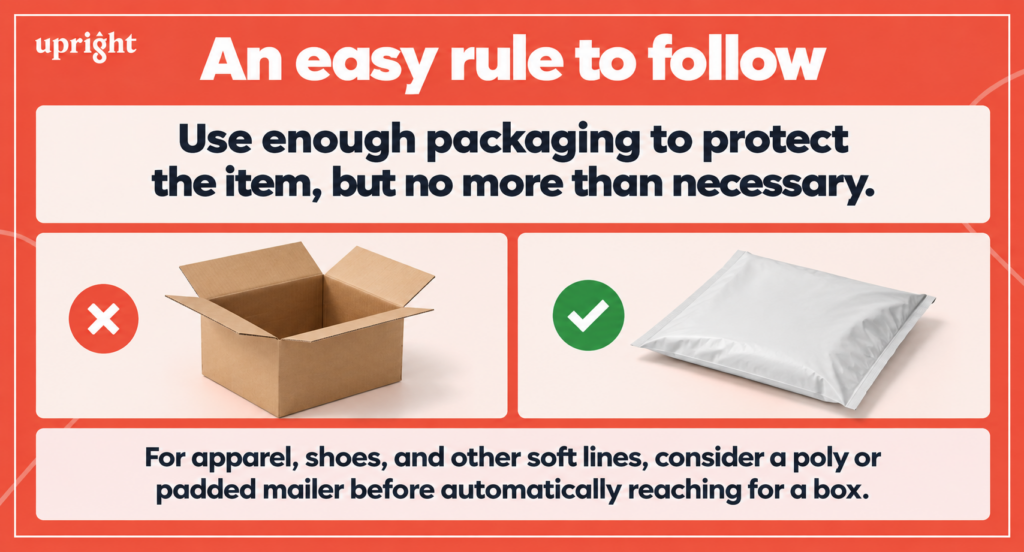
An easy rule to follow:
Use enough packaging to protect the item, but no more than necessary.
For apparel, shoes, and other soft lines, that often means considering a poly or padded mailer before automatically reaching for a box.
2. Understand Dimensional Weight and Carrier Standards
Shipping weight isn’t the only measurement that matters.
Large boxes consume valuable cargo space whether they contain a lightweight jacket or a 20-pound appliance. That’s why carriers may calculate a package’s dimensional weight, or DIM weight, based on its length, width, and height.
For USPS Ground Advantage parcels over one cubic foot, the Postal Service compares actual weight with dimensional weight and uses whichever is greater.
Carrier standards also vary.
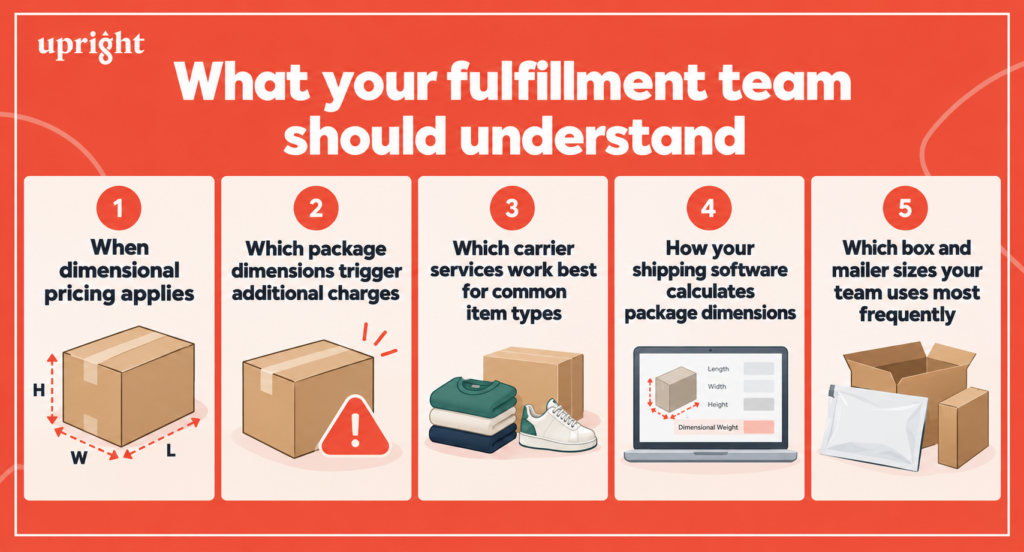
Your fulfillment team should understand:
- When dimensional pricing applies
- Which package dimensions trigger additional charges
- Which carrier services work best for common item types
- How your shipping software calculates package dimensions
- Which box and mailer sizes your team uses most frequently
Within Upright Lister, administrators can configure shipping box padding, control available carrier services, and enable automatic selection of the lowest available shipping rate.
3. Right-Size Boxes and Enter Package Information Carefully
Instead of dropping an item into the nearest large box and filling the empty space, fulfillment teams should match the package as closely as practical to the item.
Right-sizing reduces wasted space and packing materials while helping prevent unnecessary dimensional-weight charges.
Accuracy matters just as much.
If you’re purchasing labels yourself, your shipping carrier needs the correct:
- Package type
- Weight
- Length x Width x Height
Incorrect measurements can lead to postage adjustments or additional carrier fees.
This is especially important for thrift because your team isn’t shipping the same SKU over and over. Every unique item creates another opportunity for an incorrect weight, measurement, or package choice.
A simple packing workflow, calibrated scales, organized packaging supplies, and clear employee training can prevent small errors from becoming expensive habits.
4. Compare Carriers and Service Levels
The best shipping option for one order may not be the best option for the next.
A lightweight shirt traveling two states away may have a very different lowest-cost option than a 25-pound stereo traveling across the country.
Instead of relying on one carrier or service across the board, compare available rates whenever practical.
If you sell through eBay, eBay Labels provides negotiated USPS, UPS, and FedEx rates. eBay says those negotiated rates can save sellers money compared with purchasing many services directly at retail rates.
Different services can also make sense for specific inventory.
Don’t overlook Media Mail
USPS Media Mail can be a cost-effective option for qualifying books and other eligible media. But eligibility matters.
Books of at least eight pages, printed music, sound and video recordings, and certain other educational materials can qualify. Video games and computer drives do not.
USPS currently lists Media Mail with an estimated delivery standard of 2–8 business days, compared with 2–5 business days for Ground Advantage.
If you choose a slower shipping option, make the expected delivery timeline clear to buyers.
For more detailed shipping configuration strategies, see Upright’s earlier How to Reduce E-Commerce Shipping Costs article and Ship Smarter, Not Harder Master Class.
5. Track Shipping Margin, Not Just Label Cost
Finding a cheaper label is useful, but it doesn’t tell you whether your shipping operation is profitable.
Thrift teams should also compare what the customer paid for shipping with what the organization actually spent to fulfill the order.
One useful calculation is:
Shipping Margin = (Shipping Paid by Customer – Label Cost) ÷ Shipping Paid by Customer
Upright recommends reviewing this data to understand whether shipping settings, carrier percentages, free-shipping promotions, or flat-rate policies are helping or hurting margins.
For example, you may find that:
- Clothing consistently produces a healthy shipping margin
- Large housewares frequently cost more to ship than buyers pay
- Certain box sizes trigger more dimensional-weight charges
- One carrier performs better for lightweight inventory
- Certain employees or packing stations generate more carrier adjustments
Those patterns give you something actionable to improve.
The real cost of fulfillment is more than postage:
True Fulfillment Cost = Postage + Packaging + Labor + Adjustments
A label that is $0.50 cheaper isn’t necessarily a better option if the workflow takes significantly longer or requires more expensive packaging.
Reducing E-commerce Shipping Costs Through Better Workflows
Better shipping starts before an order ever reaches the packing station.
Optimizing workflows upstream can reduce the incorrect inventory information, packing mistakes, and manual decisions that create fulfillment problems later.
That’s one reason Upright Labs is building The Complete Thrift Ecosystem, connecting intake, retail, AI-assisted workflows, inventory management, and e-commerce more closely across the secondhand operation.
Greater data visibility throughout the item lifecycle can help teams reduce mistakes caused by incomplete or incorrect information.
Within Upright Lister, shipping tools can also help standardize the fulfillment process. Teams can control available carrier services, require items to move through Pack Mode before labels are created, configure package padding, connect carrier accounts, and automatically select the lowest available shipping rate.
Lister’s Shipments Report also gives organizations visibility into label costs and buyer-paid shipping, helping teams evaluate shipping performance over time.
Carrier rates may continue to change, but packaging choices, accurate measurements, smarter service selection, and better fulfillment workflows are all within your team’s control.
At Upright Labs, we’re building tools that help thrift organizations streamline e-commerce from listing through fulfillment.
Schedule a demo to learn how Upright Lister can help your team list, manage, pack, and ship secondhand inventory more efficiently.