
“What thrift items should I sell online, and what goes in store?”
The answer reveals a hard truth: Not every item should go online and not every item that’s sold online makes a justified profit.
Welcome to the complex world of thrift e-commerce economics.
In this article, we’ll explore the real costs of selling online and how to determine which goods belong in e-commerce. And we’ll tackle the logic behind setting minimum prices.
What’s worth selling online?
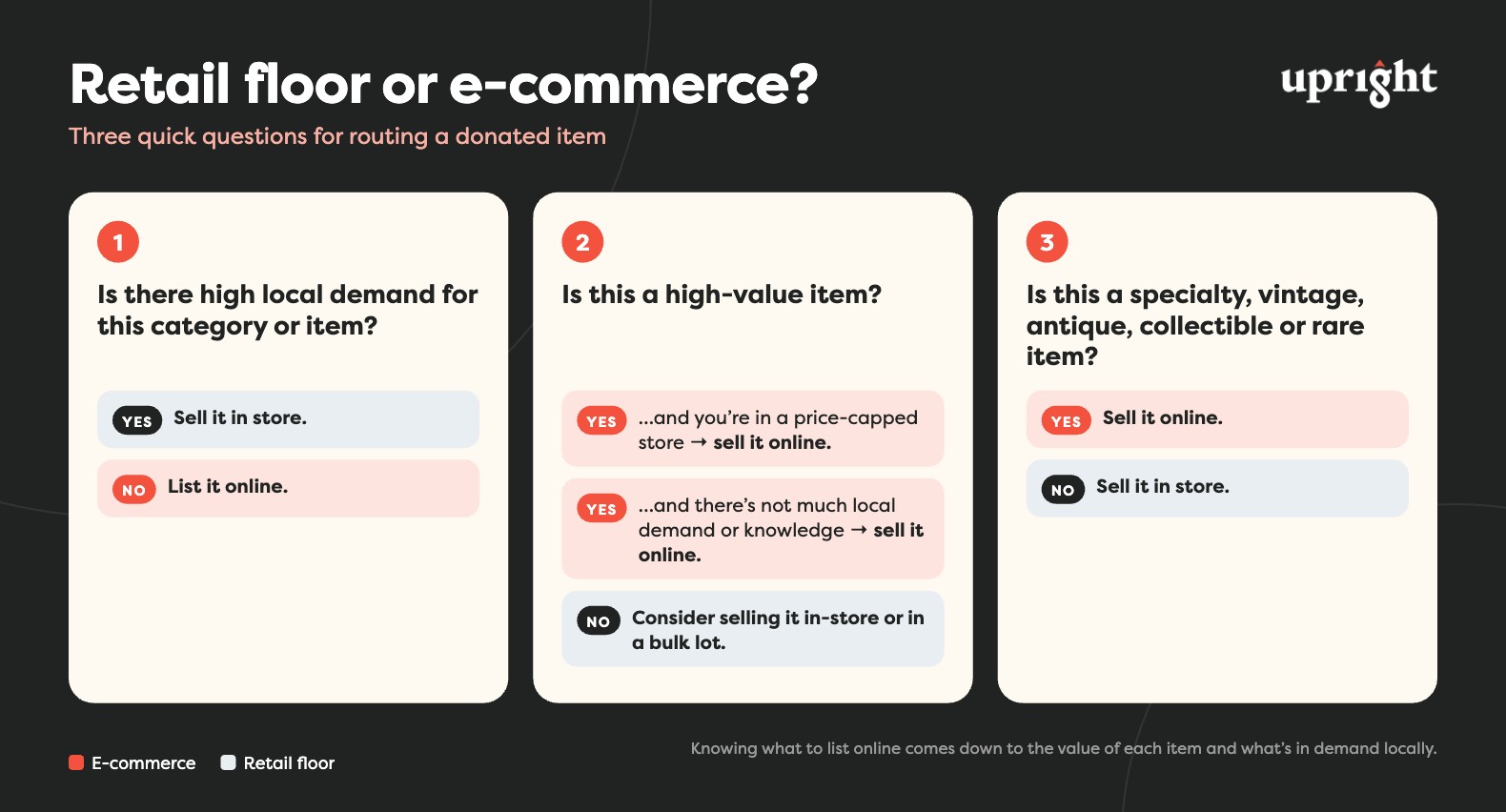
First, let’s talk about the decision of what to sell online vs. in-store. This is usually straightforward:
Is there high local demand for this category\item?
If yes—sell it in store. If no, list it online.
Is this a high-value item?
If yes and you’re in a price-capped store, sell it online.
If yes and there’s not much local demand/knowledge, sell it online.
If no, consider selling it in-store or in a bulk lot.
Is this a specialty, vintage, antique, collectible, or rare item?
If yes, sell it online. If no, sell it in store.
For clothing, shoes, and accessories, the following items usually get higher revenue online:
- Vintage items (e.g. band t-shirts)
- Luxury items
- Designer/branded items
Other items can be sold in store.
The bottom line is that knowing what to list online comes down to two things: the value of each item and what’s in demand locally. For example, some thrift stores have standing orders that all musical instruments are sold online, where demand is higher.
For a more comprehensive list of e-commerce shopping trends, download our newly-updated 2026 Thrift Trends Guide.
What’s worth selling on eBay vs. ShopGoodwill?
At the time of writing this post, the following categories were top sellers on eBay:
- Electronics
- Tablets, smartphones, computers, accessories, and parts
- Home and wearable tech
- Video games and consoles
- Fashion
- Collectibles
- DIY tools
- Small appliances
Similarly, these categories are currently popular on ShopGoodwill.com:
- Jewelry
- Designer clothing and accessories
- Collectibles/vintage items
- Electronics
- Home media
- Home goods/decor
A faster way to sort and research items
Many thrift organizations have trialed standard AI tools like ChatGPT and Google Lens to help ID and categorize items. But because those programs aren't designed for thrift e-commerce's unique needs, results are inconsistent and sometimes inaccurate.
Thrift leaders that have tried pearldive Ama Sorter have cut down sorting times, reduced errors, and improved productivity by 200-300 percent.
What minimum price should I set to sell thrift goods online?
Now that we’ve dealt with the categories, let’s drill down into item-level pricing. And here’s the plain fact:
Item pricing depends on more than just market value.
While market value is an important guideline, e-commerce listers also need to understand overhead costs before setting a minimum price.
Understanding selling costs
You’ve heard of the break-even threshold, i.e. the sale price you need to cover costs. Anything under this threshold means your business is ultimately losing money.
Let’s say you have a donated item that you want to list for $15. It’s all profit, right? You didn’t pay for the item.
Not quite. Every item sold has to pay for more than just its listing fees. The real cost of sales—retail or e-commerce—includes:
- Listing labor cost (employee time x hourly wage)
- Fulfillment labor cost (employee time x hourly wage)
- Packaging expenses (i.e. cost of packaging materials)
- Shipping/postage fees
- Platform fees (i.e. a flat per-listing fee or a percentage of the final sale amount)
- Other advertising fees (i.e. promotional fees)
- Share of operating expenses (building fees, inventory/storage costs, utilities, IT infrastructure, software, etc.)
Some of these are per-item fees; some are each item’s share of e-commerce/retail overhead. Either way, they all add up. For example:
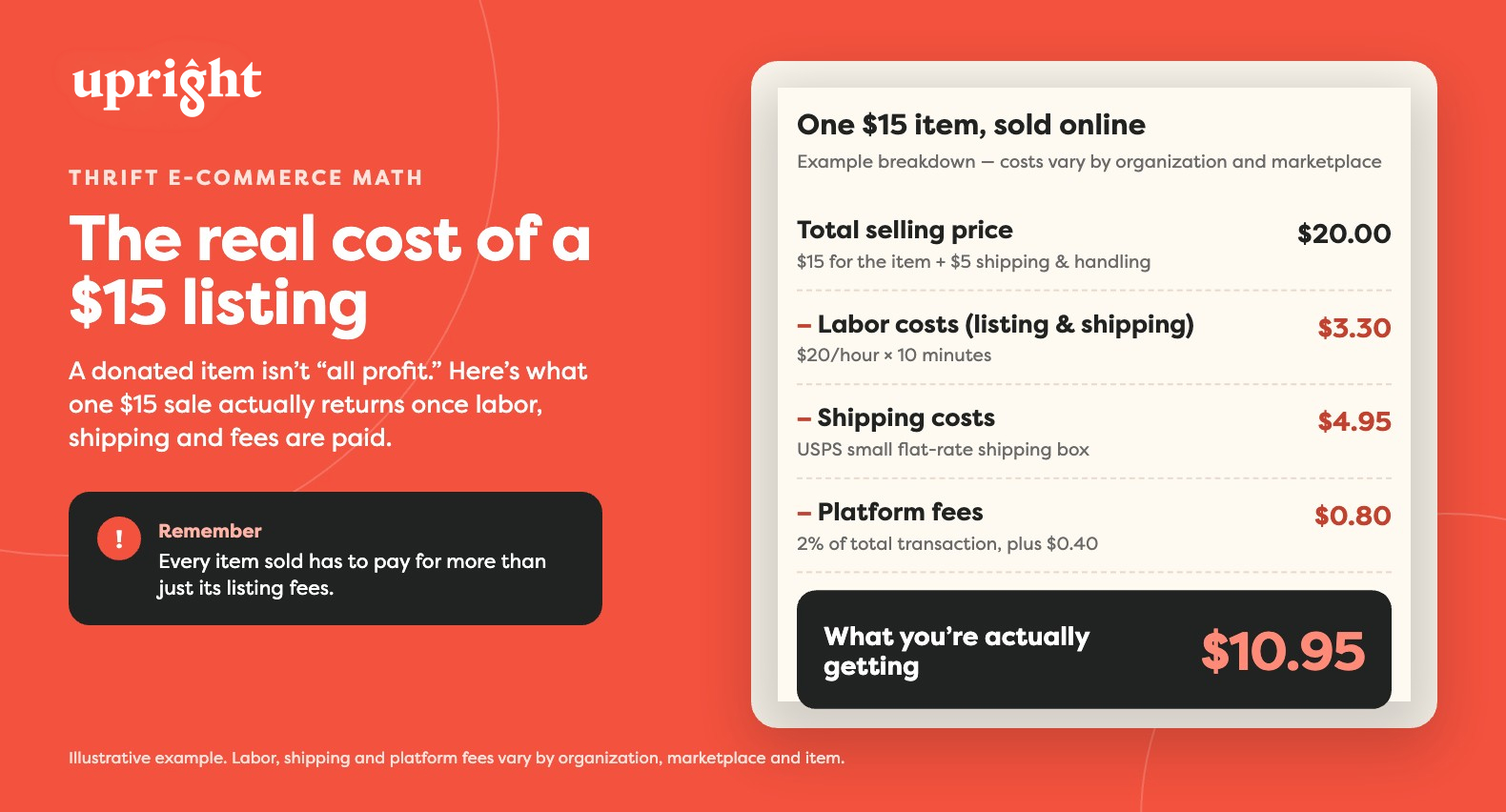
Many of these costs fluctuate. Some—particularly labor costs—can be reduced by connecting systems and automating certain operations. This lowers employee time spent on manually sorting, listing, and pricing items. It also eliminates duplicate entries and effort across retail, e-commerce, intake, and processing functions. You can learn more about connecting systems in our Complete Thrift Ecosystem.
Finding market values
Now we’re at the last piece of the minimum e-commerce price puzzle: the market value. Identifying this is critical to sales. Price it too low and you’ll leave money on the table. On the other hand, a high price may mean the item doesn’t sell quickly—or at all. This can lead to low sell-through rates, which cost more in long-term storage and slow revenue flow.
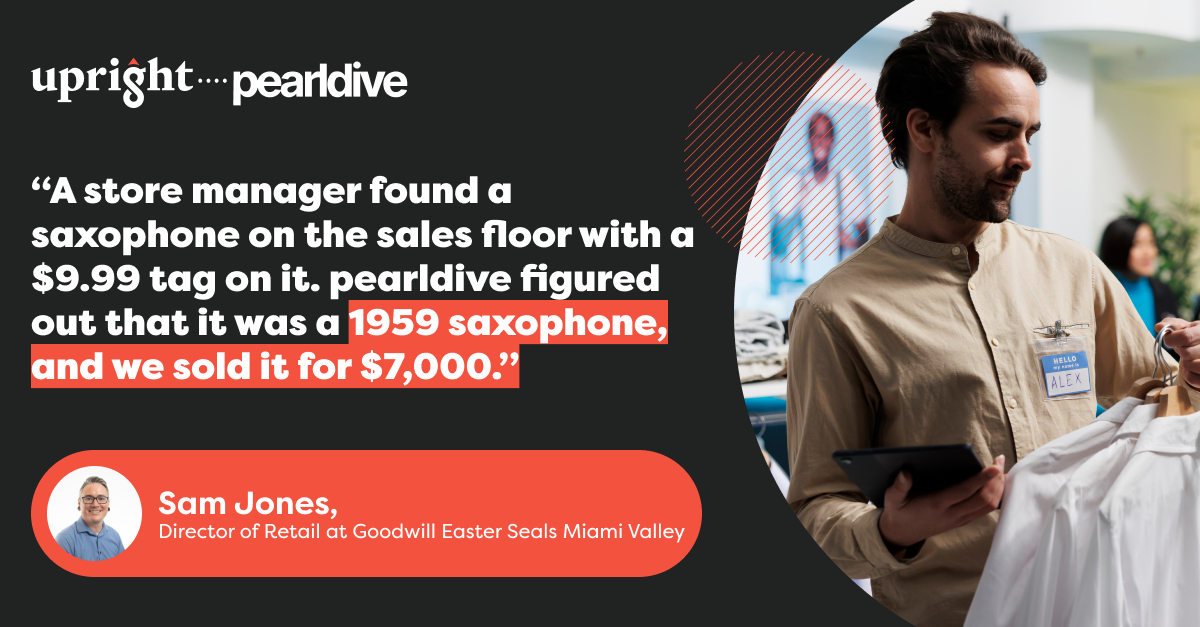
Manually pricing items can take 15 minutes or more. And if the item is rare, you may need to wait for expert identification and valuation. This drags down listing speed and drives up labor costs, so thrift stores are increasingly turning to AI to speed up the process. AI tools that are built for thrift, like pearldive’s Ama Sorter, have been seeing great results in the field. In fact, Ama Sorter even allows teams to set item price thresholds to automatically recommend selling in store or e-commerce based on the item’s value.
Adjusting the Starting Price
Many thrift e-commerce teams opt for auction sales. In this case, setting the minimum price is actually setting a starting price. We commonly see teams use price thresholds (i.e. starting at $9.99, $12.99, $39.99, etc.) for most items and going as high as $100 for rare or valuable items. The bidders basically set their own final price.
If an item doesn’t sell at its listed starting price, most teams will start stepping that price down by a dollar or two until it sells or try a new marketplace. This is one of the ideal features of Upright Lister’s Listing Strategies function.
But there’s a handy rule of thumb for setting online auction starting bids: If most of your listings are selling on the first try, consider gently upping your opening prices. If you’re getting a lot of relistings, drop the starting price by a buck or two until you find the sweet spot.
A Smart Minimum Pricing Strategy Is Key to E-Comm Success
The math behind thrift e-commerce minimum prices contains many variables. But success in your pricing strategy hinges on three things: keeping costs low, keeping items moving, and keeping prices in the magic zone between the break-even point and the market value.
Fortunately, advances in connected systems and AI tools for thrift operations have made this equation easier to solve. With AI providing decision support at sorting and automation during listing, thrift teams have cut costs and boosted revenue. If you want to learn how to do the same for your organization, check out our Thrift Trends Guide. Or contact our team to discuss connecting and streamlining operations.
Frequently Asked Questions
What thrift items should I sell online?
High-value items that are unique, specialized, or rare are good candidates for online sale. Categories like jewelry, collectibles, luxury/designer clothing, and niche goods also usually do well in e-commerce sales.
Need some more guidance? Try pearldive Ama’s Guides section. Users can build instructional donation sorting guides for their teams by asking a simple question like, “What are some designer clothing tags to watch for?”
What is worth selling on eBay? What should I sell on ShopGoodwill?
Most eBay searches are optimized around brand, item name, and other specifics, so well-documented items (e.g. with lot or ID numbers, brand names, etc.) are a good choice. Vintage items, home decor, and jewelry are top contenders on ShopGoodwill; however, there is a lot of overlap between the two marketplaces.
How do thrift stores set minimum prices? What’s the minimum price to sell on eBay, ShopGoodwill, or other e-commerce platforms?
Thrift stores need to determine the market value of the item plus their own overheads to set a sustainable minimum price.
When should thrift stores sell online vs. in-store?
If items have high value but low local demand, they should go online. Items that are lower in value with high local demand should go in store.