

For mission-driven thrift organizations, accessibility—making it easier for differently-abled people to do their jobs—is an important part of store and warehouse management.
The goal isn’t just to make money for the community or a cause; it’s also to provide roles for people with differing levels of ability.
What “Accessibility” Means in Thrift
Accessibility: making it easier for differently-abled people to do their jobs. For mission-driven thrift businesses like Goodwill, the workforce isn’t a line item—providing meaningful roles for people of all ability levels is part of the mission itself.
AI is often hyped as a solution for improving operations, but it can also improve workflows for people of every ability level. All workers benefit from tools that make their jobs easier, faster, and more effective. So, let’s look at how AI tools designed for thrift organizations can improve accessibility for employees while also enhancing warehouse operations and overall revenue.
In Thrift, Not All AI Is Created Equal
First, we have to clarify that standard AI and AI that’s built specifically for secondhand retailers get very different results in thrift organizations. General AI provides general guidance, but it may actually add work rather than simplify it.
As an example, compare the two images below:
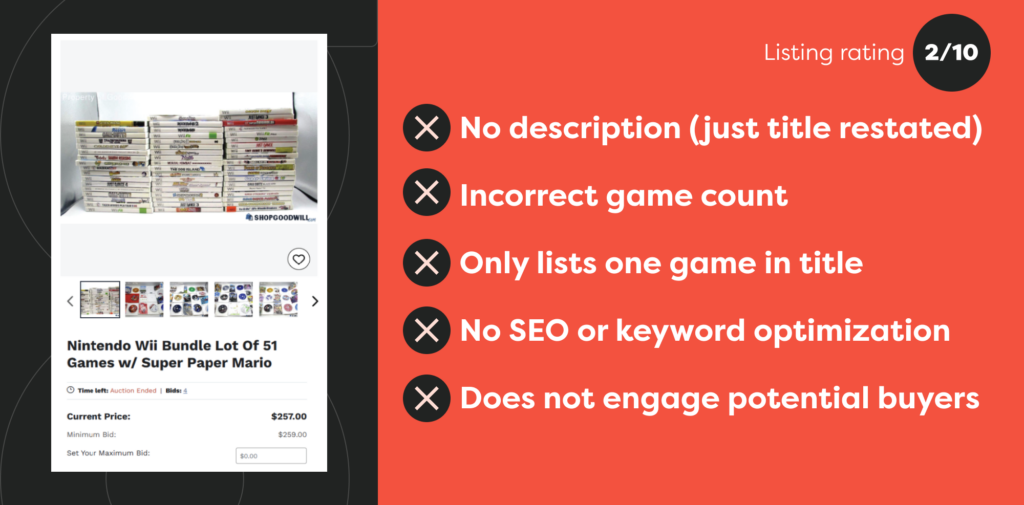
Both tools used AI to do the same thing: automatically identify and list items for online sale. But the results are very different.
The information on the standard AI version is sparse and unengaging:
- There’s at least one mistake.
- There’s no search engine optimization.
- There’s only one game in the title.
- Individual game titles are not included in the description.
In this situation, the employee has to add info, rework the listing, and spend precious time and thought on making it appealing. Using a generic AI tool here provides little savings over listing the item manually.
Now compare this with the second image:
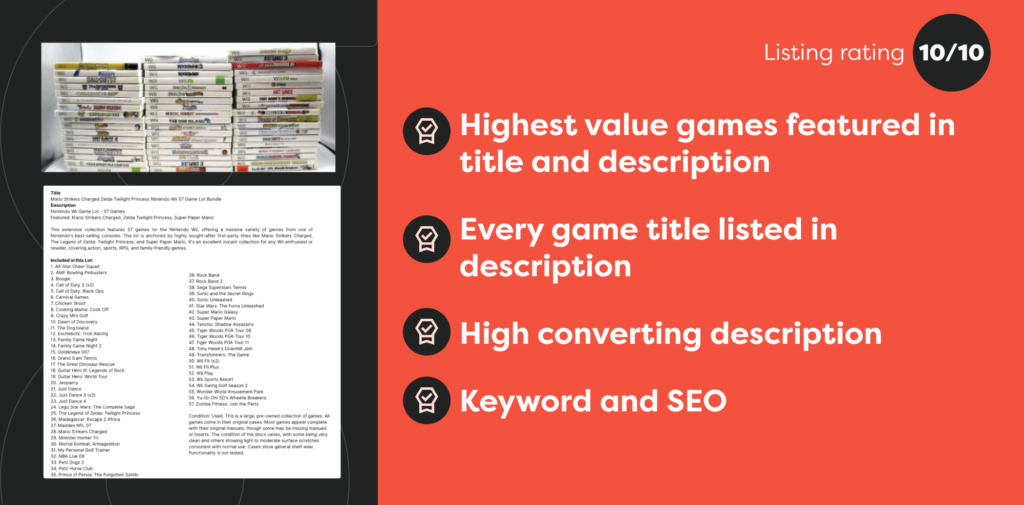
- Product information is full and accurate.
- All 51 games are listed in the description.
- The highest-value games appear in the listing title.
- Photos are clear and professional.
- The listing title and description are SEO optimized and ready to post.
Accessibility Is More Than Tools
However, accessibility doesn’t just mean providing time-saving tools that automate listing and sorting. It also means ensuring workers have the knowledge they need to make accurate decisions.
For secondhand retailers, this has traditionally been a challenge. Item expertise is usually limited to one or two employees; a store might have someone who knows glassware, someone who knows collectible toys, someone who knows vintage clothing, etc. But when that person isn’t available, neither is their expertise. Teams are left guessing about the values and even the correct identification of donated goods.
With specialized AI, this knowledge fits in a mobile device and is available to employees of differing ability levels. After piloting pearldive, Goodwill Easterseals Miami Valley’s Sam Jones called it “an expert in every backroom that you don’t have to retrain every couple of weeks”.
“A district manager was just calling to say, this thing is user-friendly. It’s fantastic. I spent time at one of my busiest best stores today for the rollout, and we found so much stuff. […] We got the tool in [one manager’s] hand on a Tuesday, and she was calling me on a Thursday to say, ‘I’m pulling stuff out of salvage. I’m pulling stuff off my sales floor. I’m pulling stuff we wouldn’t think was valuable at all, and it’s coming up, like, an $85 baby doll.’”
— Sam Jones
Director of Retail, Goodwill Easterseals Miami Valley
Instead of being dependent on a few key workers or painstakingly accumulating knowledge through trial, error, repetition, and research, any team member has the tool they need to confidently move forward with pricing, categorization, and stocking decisions.
This reduces stress, pressure, and uncertainty for employees. In the big picture, it means fewer high-value items are missed and more income is generated. Plus, it allows multi-location operations to standardize their practices, evening out some of the disparity between high- and low-performing stores.
With pearldive, Training Is Easier Than Ever
Another area where secondhand retailers need to pay attention to accessibility is during training and onboarding. A simple and straightforward training process improves memory retention and recall for everyone. Tools that are easy to understand and easy to use are essential for workers facing a variety of challenges.
When you’re using standard AI, training can be different for each location. When a tool is not optimized for any particular use, it’s also not optimized for training for a specific use. Generic AI tools often take months prompting and training before they’re somewhat effective for thrift operations. Thrift AI tools like pearldive are ready from Day 1. Our team understands the secondhand retail environment and knows how tools will be used. That equates to a smoother and faster learning experience.
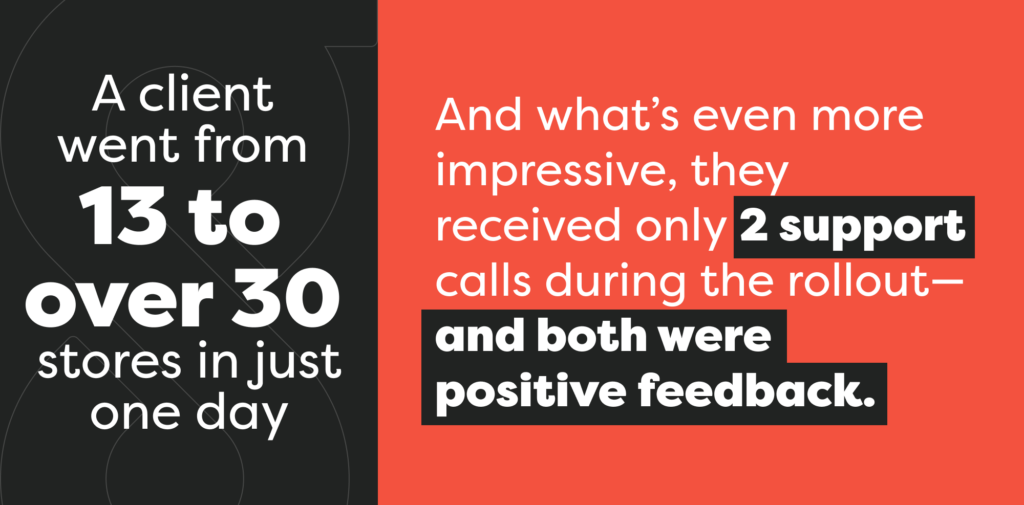
pearldive’s sorting and listing tools require very little training. Once workers are shown how to take pictures of the item or enter a text description, the AI engine assists the rest of the way. These tools are so easy to use that one of our clients expanded their rollout from 13 stores to over 30 stores in just one day. And what’s even more impressive, they received only 2 support calls during the rollout—and both were positive feedback.
“I literally just put together an email with some screenshots […] A couple of screenshots, a couple of pointers, and they’re off to the races.”
— Sam Jones
describing the training process for pearldive’s Ama Auto-Sorter
How Much Can AI for Thrift Empower Your Workers?
Our thrift clients are proud to provide career training and support for people of all abilities. And we’re proud to support them with technology that simplifies training, workflows, and intake processes.
When our clients use purpose-built AI for thrift tools, they’re not replacing workers. They’re giving workers the tools they need to be effective. These tools reduce guesswork and allow people of all ability levels to be more productive. A greater number of workers can contribute and more donations can be processed—which also means more funds are available for the organization’s mission.
In fact, our clients find that AI for thrift organizations are creating more job opportunities. One organization that rolled pearldive out to multiple locations has plans to add more photographers and shippers to their e-commerce team, thanks to AI auto-listing nearly doubling their listing output.
Recently, a client told us they’re planning on expanding their e-commerce operation and doubling photographers because of pearldive’s impact. They’re adding more shippers, too. They’re 30% ahead of last year in revenue, and that’s opened up more jobs.
If you’re ready to learn more about pearldive’s impact on the thrift landscape, download our whitepaper, The AI Transformation of Thrift E-commerce.
And we hope you’ll join us for a special webinar on how AI-driven automation is helping secondhand retailers improve throughput, listing quality, and revenue.
Finally, if you want to try pearldive’s AI listing tool for free, you can get 100 listings without spending a cent at pearldive Auto-Lister.