

There’s a version of the AI conversation floating around thrift right now. It goes like this:
“AI tools are making things faster, but they’re replacing our people.”
That’s an understandable concept, but it’s the wrong framing for this conversation.
Why wouldn’t we think like this? Nearly every piece of science fiction produced over the last century has used this kind of theme. From Asimov to “I’ll be back” to Morpheus’ red and blue pill, it’s basically embedded in our thinking.

For Goodwill, Salvation Army, St. Vincent de Paul, Habitat ReStores, and other mission-driven thrift operators, their workforce isn’t a line item. Job placement, training, inclusion, and community opportunity are a major facet of their identity.
So, if AI is going to matter in this space, it has to be a part of the mission itself.
Not Just a Generic AI Tool
At Upright, we’ve always made it our priority to help secondhand organizations make more revenue from every donation, so YOUR mission can thrive.
That’s why we love that pearldive is not a generic AI tool wedged into the thrift industry.
pearldive is an AI tool built by thrift operators for thrift operators. It’s specialized for donation and resale workflows from intake to listing. It’s built by people who understand how secondhand operations actually work, day-in day-out.
This differentiation matters more than many realize.

“pearldive was built on a simple idea. If someone donates something valuable, a thrift organization should have the tools to recognize it, route it correctly, and maximize its value for the mission. ”
Jake Adair, VP pearldive
10+ years as a Director of E-commerce at Goodwill and America's Thrift Store
Cognitive Load is The Issue
Historically, thrift intake and listing has depended on experience.
For the last 20 years, online resale has looked like this: There’s usually 1 or 2 specialists who know what brands matter, a person (or printed sheet) telling the team what should be sold online, someone taking the time to research prices of oddball items, a person sorting through bulk lots to try and find a diamond in the rough (maybe literally), and so on and so on.
The issue here is that most of that knowledge can change quickly with trends, is hardly ever fully documented, and rarely retained. It just lives in a few employees heads. This sort of working style can create a fragile operation.
When the expert is off that day, out sick, or leaves the organization, the knowledge leaves with them too.
New people come in and have to learn by repetition, correction, and time. Multiply that across dozens of stores, frequent turnover, volunteers, and constantly changing donated inventory, and it becomes easy to see why thrift teams end up relying on guesswork.
While many teams have great effort, amazing commitment, and genuine care, the bottlenecks come back to guesswork and inexperience.
Generic AI tools do not solve that problem on their own. In fact, they can add more mental overhead. If the tool is not built for thrift, the user still has to figure out whether the answer is right, whether it fits the workflow, and what to do with it next.
So, the tools acquired to solve thrift store problems, just created more work.
What Makes pearldive Different
pearldive is built specifically for secondhand and thrift workflows.
Unlike generic AI tools, it doesn’t just generate answers, but instead pearldive helps teams make the next operational decision in their process:
- What is this?
- Should this item be sold in-store or online?
- What’s the best title for this item?
- What details matter to the buyers?
- What category should it live in?
- How can we make this listing more visible, so we can get the most value from it?
With pearldive’s sorting tool, Ama, thrift teams can evaluate donated goods at intake and instantly receive a recommendation on where the item should go.
Pair that with pearldive’s listing tool, Auto Lister, and teams can turn a few product photos into detailed, museum-quality listings in seconds.
Instead of spending 10 minutes or more doing manual research, writing descriptions, searching categories, and figuring out best pricing, employees are able to get through manifests faster than they ever could before.
The results are effective, because pearldive is already built and trained for thrift stores.
Teams could spend weeks attempting to train generic AI tools with hyper-specific prompting, trying to get it to learn about the donated goods industry, and still wonder whether the output is trustworthy enough to build workflows around.
There’s no uncertainty around pearldive.
“With pearldive, you’ve got an expert in every back room now that you don’t have to retrain every couple weeks.”
-Sam Jones, Goodwill Easterseals Miami Valley Director of Retail
Better AI Workflows Create Better Employee Engagement
When thrift operations remove manual labor and guesswork, everything moves forward, goals change, and missions see the impact.
First and foremost, the employees see the biggest impact.
Employees spend less time researching unique SKUs, writing individual listings over and over, trying to remember obscure product information, and correcting inconsistencies from store to store.
Instead, they begin spending more time on:
- Intake
- Photography
- Quality Control
- Shipping
- Warehouse Flow
- Customer Service
- Scaling the Operation
The right AI implemented into thrift operations doesn’t remove people from the process, but rather sets them up for even greater success.
Sarah Challender, Director of Digital Sales at Goodwill Houston, put it well when describing her team’s experience with pearldive. After adopting the platform, they were able to transition listers into photographers while improving productivity, accuracy, item identification, and listing quality. She called it “the best product” she has worked with in nearly 14 years of donated goods e-commerce and said her team loves how much more efficient their processes are now.
pearldive makes thrift teams more effective.
Growth Over Fear
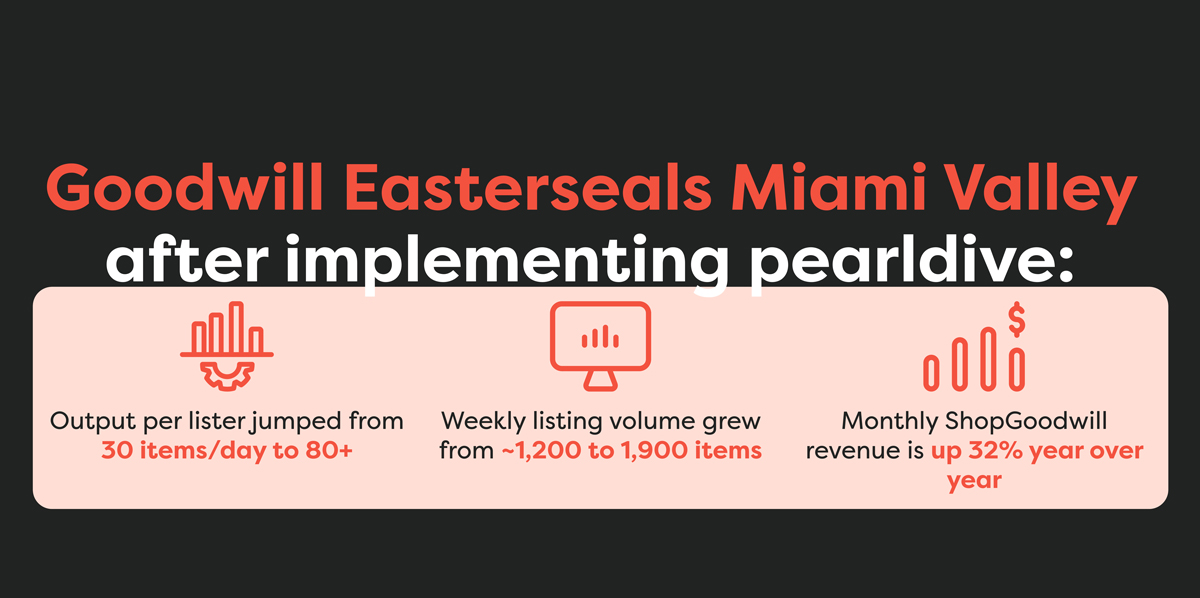
Sam Jones at Goodwill Easterseals Miami Valley described exactly what happened when pearldive was introduced in their operation.
On the listing side, output per lister moved from around 30 items a day to 80+, with some team members going over 100. Weekly volume increased from roughly 1,100–1,200 items to 1,700–1,900. Monthly ShopGoodwill revenue in Q1 2026 was up 32% over Q1 2025.
And he directly attributed that growth to the help of pearldive.
When a thrift operation grows that much that fast, it creates the opportunity for more capacity and effectiveness of staff.
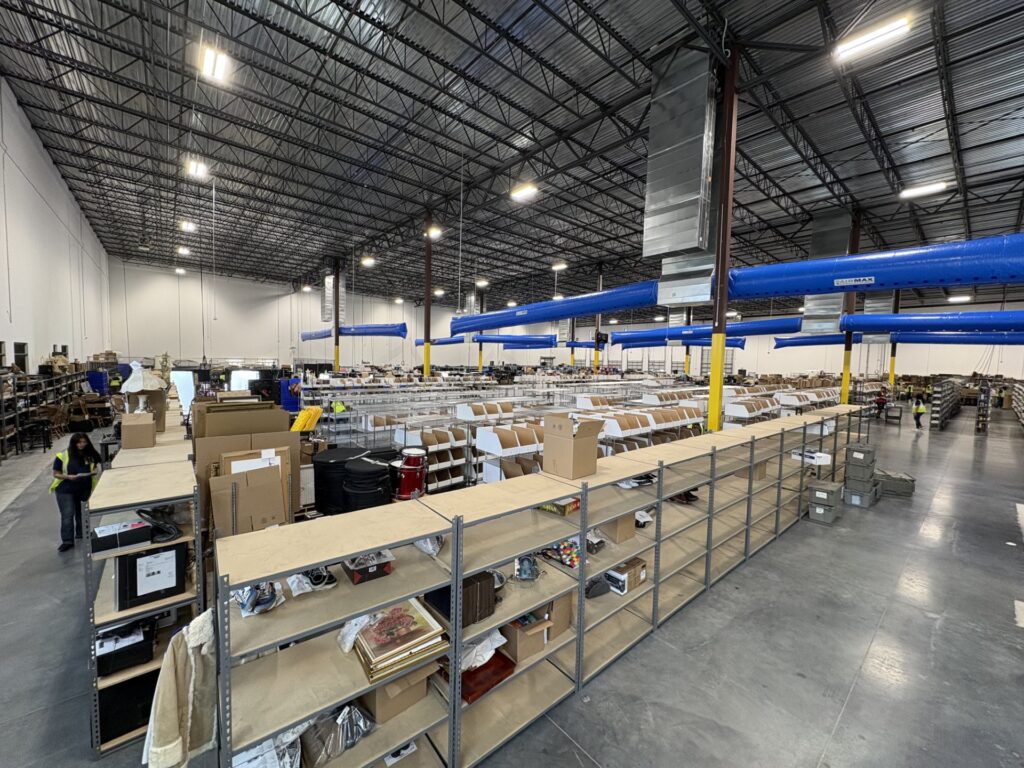
Sam explained that their team is expanding warehouse space, increasing photography capacity, and adding more shipping support because of the added volume coming through the operation. He was also direct about the labor question:
AI, in their case, is not replacing people, but is increasing what people can do and helping the organization grow faster.
The pearldive Performance Lift Is Real
We’re no longer talking about a theory, because the pearldive user numbers back up the reality.
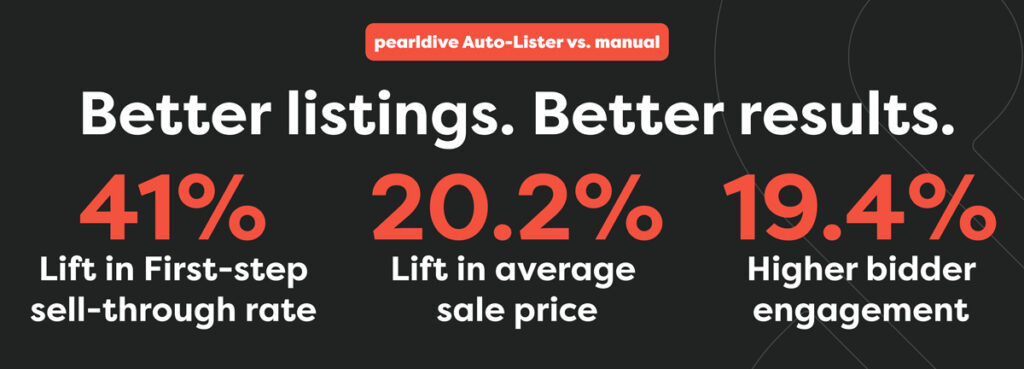
In an April 2026 comparison of pearldive Auto-Lister against manual listing, pearldive delivered:
- 46.0% average first-step sell-through vs. 32.6% manually
- 20.2% higher average sale price at $28.38 vs. $23.61
- 19.4% higher bidder engagement
Better AND quicker listings simply perform for mission-driven organizations.
And the end result for pearldive users is more items online, stronger sell-through, higher average prices, and more bidding activity from buyers. This creates more room for organizations to invest in their staff, systems, and, most importantly, the mission.
Having a structure in place to connect motivated people to specialized automation is an operational win for mission-driven organizations.
For years, thrift operations have depended on a few people who just knew what an item was, what it was worth, and where it should go. pearldive turns that unwritten knowledge into a repeatable workflow that more people can follow with confidence. That makes decision-making consistent, onboarding easier, and growth scalable without putting all the pressure on a handful of experienced staff.
AI For The People
Yes, AI built for thrift should save time. It should also help organizations capture more value from every donation, support employees and volunteers more effectively, and strengthen the mission as they grow. This is the differentiator between thrift-specific AI and generic tools that only answer questions without fitting the work.
When AI is built for the actual workflow, it makes secondhand teams stronger.
Want to see how your team can sort better and list faster with pearldive? Learn more at pearldive.xyz or schedule a demo and get your first 100 listings free.